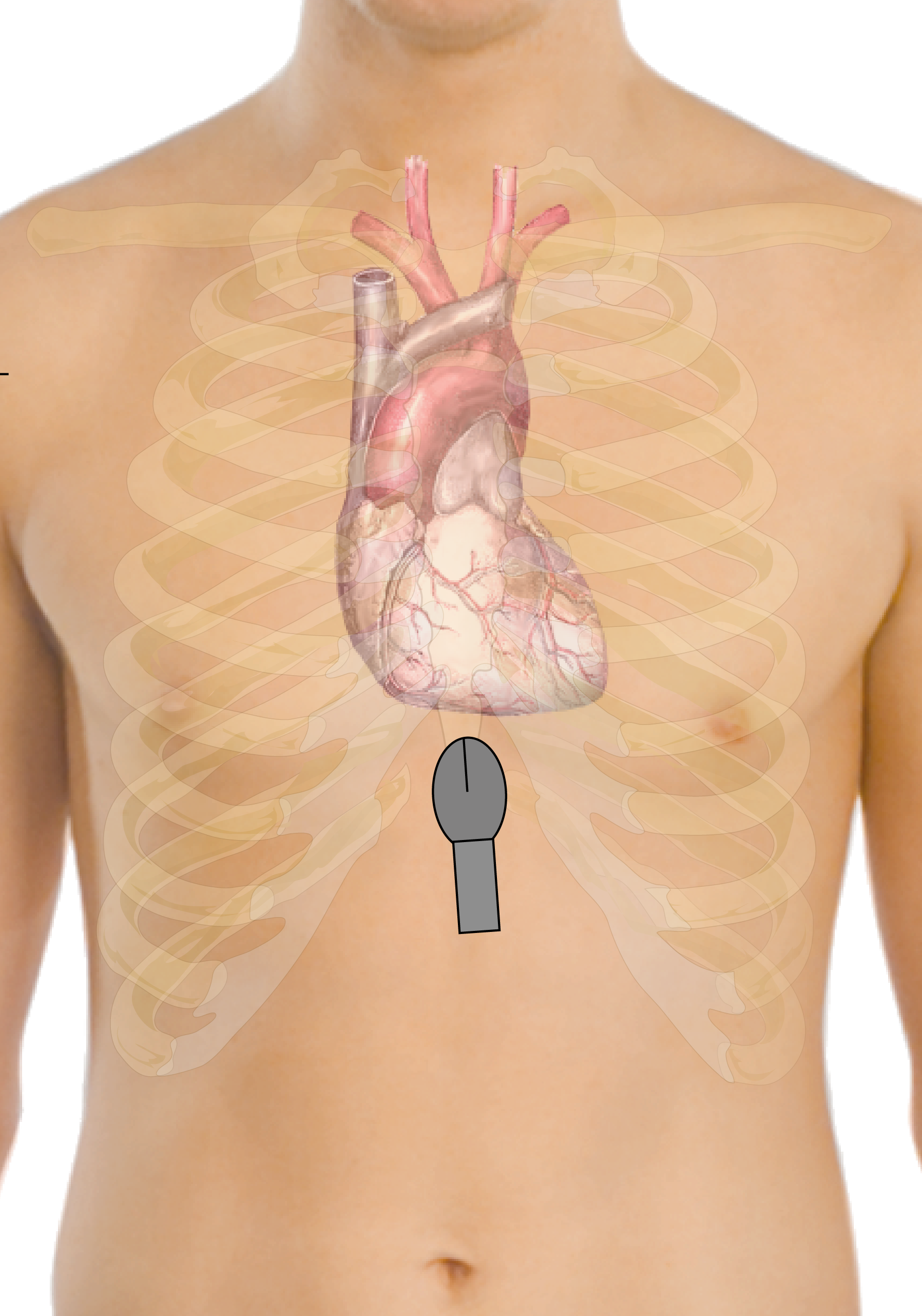
POCUS Echocardiography
General notes —
Must include at minimum 2 views (PSL, PSX, AP4, Subxiphoid and IVC), although more is always better.
Certain information can be gleaned better from certain views (right heart strain, etc.).
If unable to obtain all views — “limited” POCUS study, but in almost all patients at least two views should be obtainable if not all.
Limitations include: tachycardia, irregular rhythms, limited windows.
Always make sure the heart is within 2/3rd of the screen, dynamically adjust depth and gain.
Must be in cardiac setting – increases contrast, improves refresh rate, and improves factors that lead to better picture.
The EM orientation is preferred, although cardiology orientation will be accepted if sufficient views are obtained.
If you are not sure can use guess words – “probably normal.” If something is not visualized, do not guess.
Parasternal Long
Effusion — is there one? (must show DAo).
How big? Measure largest pocket in end diastole.
No significant
Trace
Small: 0-1cm
Medium 1-2cm
Large: >2cm
Do not confuse pericardial and pleural effusions.
Ejection —
Qualitative evaluation (eyeball), can use EPSS or Fractional Shortening (understanding limitations).
Normal — (55-70%)
Hypodynamic — CHF, MI, cardiomyopathies, toxins etc.
Hyperdynamic — LV walls almost touching eg, from hypovolemia/vasodilatory shock.
Exit — aortic root – measure, normal size <4cm.
Not as good:
Equality — RV size – can see dilated RV but not best view.
Parasternal Short
Must be at the papillary muscle view for basic POCUS echo.
Ejection — normal, hypodynamic, hyperdynamic
Effusion — present (Y/N)? Size (see PSL).
Equality — dilated RV? D-sign? Paradoxical septal motion?
Apical 4 Chamber
Equality – dilated RV?
Normal RV should be <2/3rd size of LV
McConnell’s?
Abnormal septal displacement?
Advanced: TAPSE?
See October 2023 SonoProps and dedicated chapter for more discussion about signs of right heart strain.
Ejection – normal, hypodynamic, hyperdynamic.
Effusion - Present (Y/N)? Size?
This view may be useful to see some signs of tamponade.
Tamponade is a clinical diagnosis.
Signs of tamponade include RA systolic collapse, RV diastolic collapse, MV inflow variation >25%, plethoric IVC.
Subxiphoid
Limited in patients with obesity, epigastric pain.
Potentially great in patients with COPD/hyperinflated lungs.
Techniques to optimize — have patient take a deep breath in. Bend patient’s knees to allow abdominal muscles to relax.
Effusion – best view for this. Present (Y/N?). Size?
Should be able to see the other E’s as well but not the best view. If only view there are multiple subcostal views obtainable but more advanced: subcostal short, subcostal long etc.
Inferior Vena Cava
Entrance – size and respiratory variation.
Normal — <1.5cm
Plethoric — >2cm; lack of respiratory variability means increased CVP.
Flat — touching walls; eg, hypovolemia, vasodilatory shock.
Measure size 2cm from IVC/RA junction or 1cm from IVC/hepatic vein junction.
Sniff test — have patient take a quick deep breath in to evaluate IVC collapsibility.
Do not confuse aorta for IVC.
| IVC | Aorta |
|---|---|
| Thin-walled | Thick-walled, peri-aortic fat |
| Usually towards the right (liver) | Left/center |
| Usually collapsible unless plethoric / increased RA pressure | Non-collapsible |
| Demonstrates respiratory variation | Pulsatile |
| Drains into the RA | Continues to thoracic aorta |
| Thin hepatic veins draining into IVC | Celiac trunk anterior branches |